

An English grammar game for iPhone
Fill the gap. Learn why.
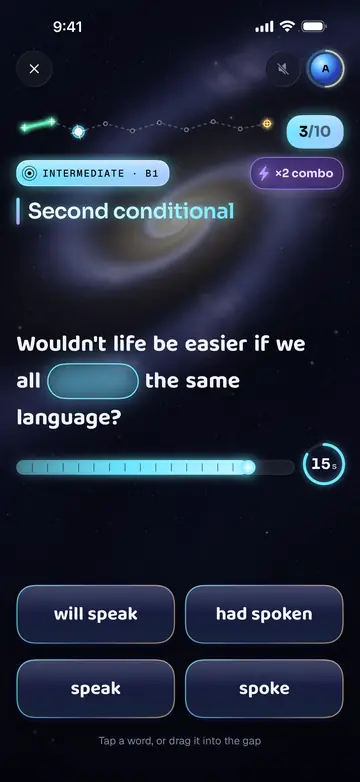
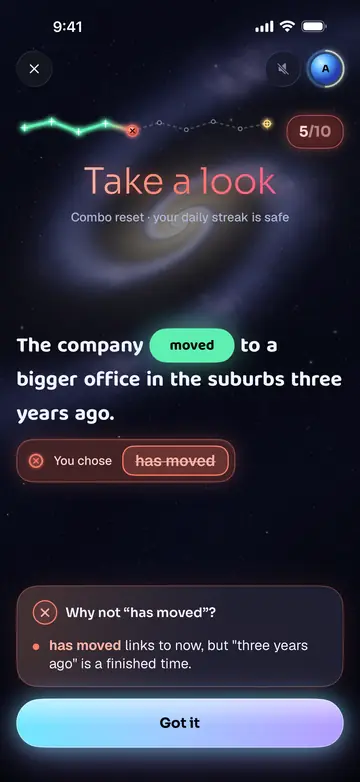
GramStar is a little game for anyone learning English. Each sentence has one word missing. You pick it from four tiles, and the app tells you why it fits. Pick the wrong one, and it tells you why that word doesn’t fit. Either way, you learn something.
Try one.
Here’s a real sentence from GramStar’s Intermediate level. Go on, tap the word you think fills the gap.
Every wrong word has its own why. Tap them all, if you’re curious.
That was one of 49,976 sentences in GramStar. They cover 170 grammar points, and every one comes with its why.
A run is ten sentences.
It takes about two minutes, so it fits into a coffee break.
-
Find the gap.
Each sentence has one word missing. Four words wait underneath.
-
Pick a word.
Tap the one that fits, or drag it into the gap. Intermediate and Advanced have a timer. Beginner doesn’t.
-
Read the why.
A right answer gets a card called “Why it works”. A wrong one gets “Why not…?” and the reason. This is the part where you learn.
-
Get your medal.
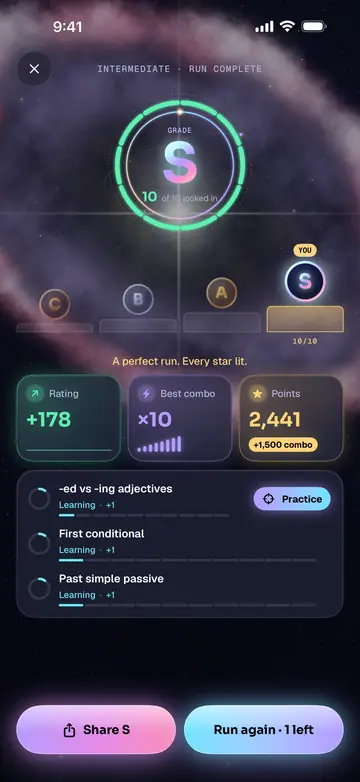
After ten sentences, you get a grade. Six or more right wins a medal: C for 6, B for 7, A for 8 or 9, and S for all 10.
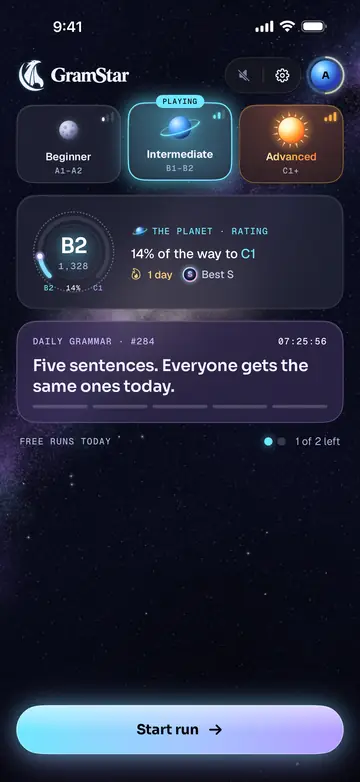
Pick the level that feels right.
There are three. Not sure which one is yours? A two-minute placement test finds it for you. You can switch whenever you like, and each level keeps its own rating.
-
Beginner
Everyday basics: tenses, a/an/the, in/on/at.
A sentence from this level
At night, I look at the moon through my telescope.
Why: We have only one moon, so use the.
-
Intermediate
Work and exam English: conditionals, the passive, reported speech.
A sentence from this level
Our dog howls whenever he hears a siren.
Why: “Whenever” shows a repeated event, and “he” (the dog) is singular: hears.
-
Advanced
Polish and nuance: inversion, the subjunctive, formal linking.
A sentence from this level
Seldom have we spotted so many shooting stars in a single night.
Why: “Seldom” begins the clause, so the present perfect inverts: have we spotted.
The timer keeps things lively. If you’d rather take your time, you can turn it off in Settings.
Small reasons to come back tomorrow.
Grammar sticks when you come back often, even for two minutes. So GramStar keeps a few things going for you. Here they are in alphabetical order, because this is a grammar game.
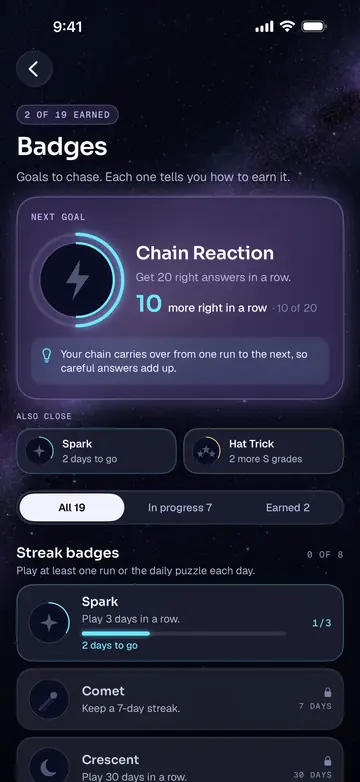
- badge noun
- There are 19 to collect. Spark is for playing 3 days in a row. Supernova, the rarest, is for a 5-year streak. Each badge tells you how to earn it.
- daily goal noun
- How many runs you’d like to play each day: Casual is 1, Steady is 2, and Intense is 5 (with Nova). GramStar tells you when you’ve done it.
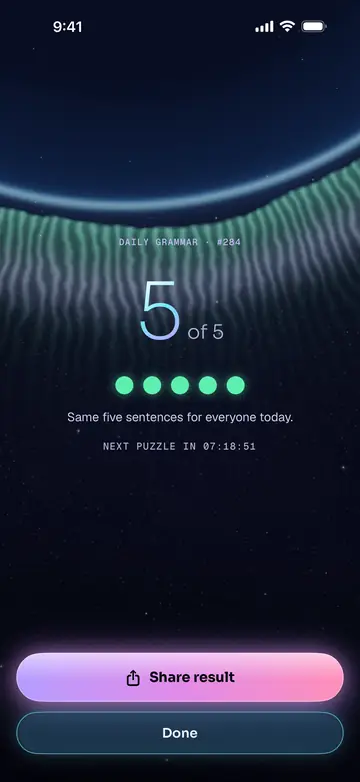
- daily puzzle noun
- Five sentences, the same for everyone at your level that day. It’s free, and it comes on top of your runs.
- medal noun
- Your prize for 6 out of 10 or better: a bronze C, a silver B, a gold A, or a platinum S for a perfect run.
- practice noun
- Five quick questions on the weakest topic from the run you just played. It uses one of the day’s runs.
- streak noun
- How many days in a row you’ve played. A day counts when you finish a run or the daily puzzle.
- streak freeze noun
- It covers a day you miss, so your streak keeps going. You earn one for every 7 days of streak, and you can hold 2 (or 5 with Nova).
- title noun
- A name you earn with a perfect run: Stargazer in Beginner, Rising Star in Intermediate, Supernova in Advanced. Once it’s yours, it stays yours.
- topic mastery noun
- A bar of ten parts for each grammar point. It shows how many of your last ten answers on that topic were right.
What’s free, and what Nova adds.
GramStar is free to play. Every day you get 2 runs and the daily puzzle. There are no ads, on either plan.
GramStar Nova is the paid plan. It comes as Monthly or Yearly, which renew until you cancel, or as Lifetime, which you pay for once. Prices are different in each country, so we don’t list them here. The app shows you yours, in your own currency.
| Free | Nova | |
|---|---|---|
| Runs a day | 2 | Up to 30: 15 Beginner, 10 Intermediate, 5 Advanced |
| The daily puzzle | Yes | Yes |
| A why after every answer | Yes | Yes, and fuller: the right word’s rule after a miss, plus example phrases |
| A review deck of your mistakes | No | Yes |
| Streak freezes you can hold | 2 | 5 |

Coming soon to the App Store.
GramStar isn’t out yet. Until it is, you can say hello on Instagram at @gramstar.app, or write to hello@gramstar.app.
GramStar is on the App Store.
It’s free to play on iPhone, with 2 runs and the daily puzzle every day.
Get GramStar on the App Store